
You probably hear the phrase everywhere, but what does it actually mean for you and your property listings?
Search Engine Optimization (SEO) is a set of strategies designed to improve visibility and ranking on Search Engine Results Pages (SERPs). SEO is all about signaling what your website offers, which in turn helps Google and other search engines understand and recommend your content to the right people.
The core goal of SEO is simple: increase the quantity and quality of website traffic by making your site more discoverable. This means using the right words, organizing your content effectively, and ensuring your website provides a good user experience, among other elements.
In our industry, keywords are the specific words and phrases potential buyers use when searching for properties online. Including the right keywords in your content helps search engines identify it as helpful and relevant.
Good news – we’ve already optimized this process for you! By default, when you select a domain with your property’s address (like 1234CentralAvenue.com), our system automatically uses that property address as the primary keyword phrase and your agent name as the secondary keyword, then distributes them throughout the website in the ideal “waterfall” format, which includes:
This comprehensive approach is crucial because search engines like Google analyze your entire site’s structure, including both visible content and underlying code. While the content visitors see is important, the semantic HTML elements (like headers, navigation, and footer tags) help search engines better understand and categorize your site. Our system ensures all these elements work together cohesively, creating a strong SEO foundation for your site.
For most listings, our automatic system works perfectly. However, there are special cases where you might want to customize the keyword to fit your needs.
Imagine you are the listing agent for The Palace of Fine Arts. You definitely wouldn’t want to choose “www.3601LyonStreet.com” as your URL, because even though this is the actual address for this landmark, all of us are much more familiar with its title. Because of this, its URL is – understandably – www.PalaceofFineArts.com.
If you have one of these unique cases in which a home is more easily recognizable by another name, you can easily modify your keywords by signing into Atrium and navigating to the Website Editor > Settings > SEO:
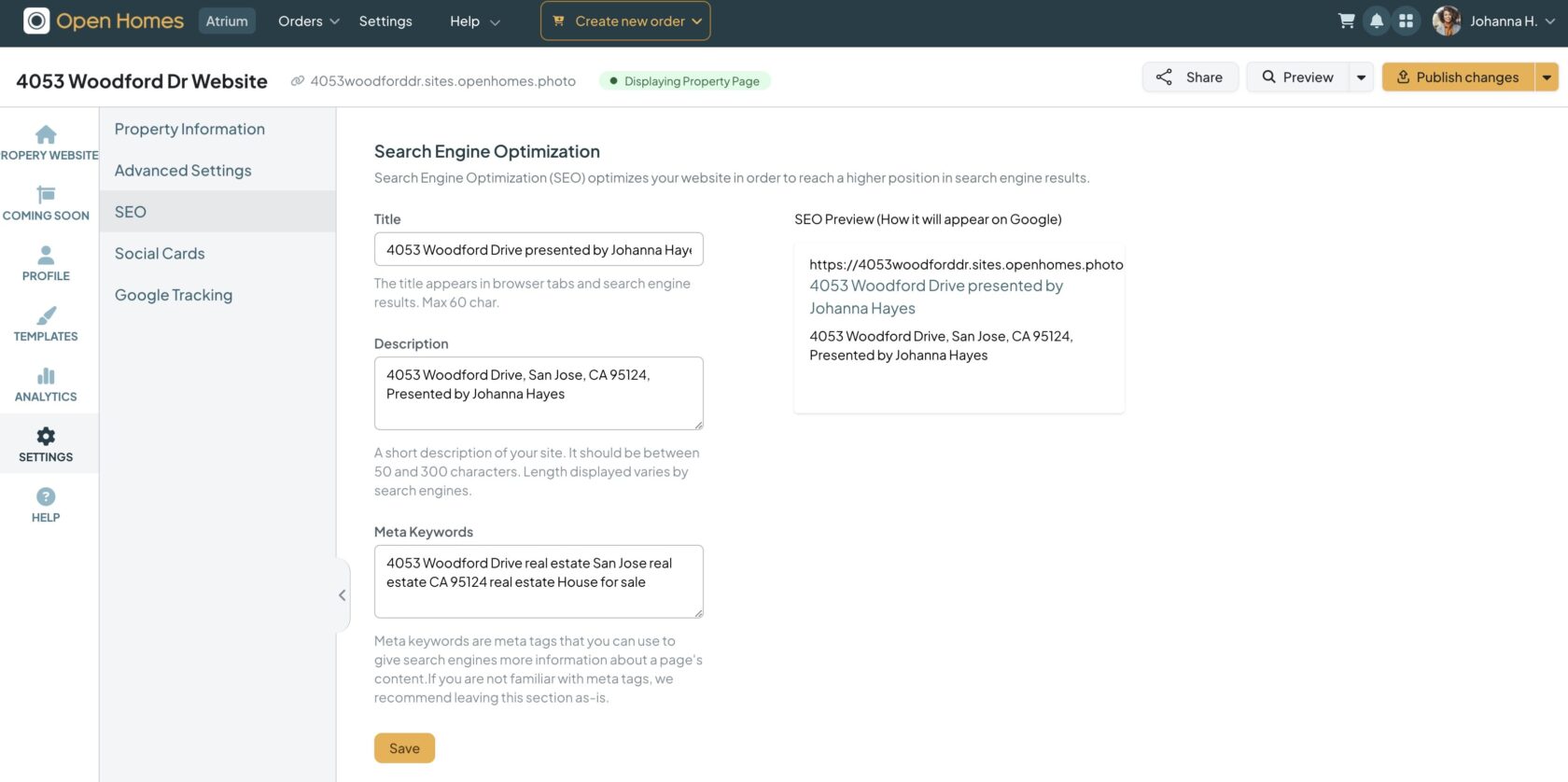
When you make these changes, our system automatically updates the keywords throughout all visible content and the underlying semantic HTML elements, ensuring search engines can properly interpret and index your site.
Let’s get meta for a second. The image above is a backlink (also called an inbound link), because the image links to another website (https://sitechecker.pro/what-is-backlink/). When a reputable website links to your property site, it’s like getting a referral from a former client. Search engines view these links as votes of confidence – essentially saying, “This website is trustworthy and its content is so valuable that we want to link to its information on our own site.”
The following list includes some examples of backlinks:
Keep in mind that the referring site must include a link to your domain for it to count as a backlink. Simply mentioning the property address in a blog post or sharing its photos in a social post will not automatically create a backlink.
Securing backlinks for your site might seem like a daunting task. Thankfully, there’s a quick way to secure 2 backlinks right off the bat!
That’s 2 “votes of confidence” that you’ve just secured for your website in no time at all. You are on your way to gaining domain authority!
Domain authority is your website’s reputation score. Much like a credit score determines your financial trustworthiness, domain authority indicates how much search engines trust and value your website.
Factors that build domain authority include:
At Open Homes, we handle the technical aspects like performance, speed, and mobile responsiveness so you don’t have to worry about them. Of course, no one can control the age of the website – that’s simply a matter of time. And realistically, if things work as they should, listings will sell quickly enough that the website doesn’t have time to age significantly!
As an agent, you can focus on what you do best: creating quality, consistent content and building valuable backlinks that showcase your expertise and the property’s unique features.
SERP features (Search Engine Results Page features) are special elements that appear on Google’s search results page, often prominently displayed above, within, or alongside the traditional organic search results. These include featured snippets, knowledge panels, local packs, image carousels, and “People also ask” boxes. These features are valuable because their prominent positioning results in excellent visibility, increasing the odds of being discovered and clicked on by users.
Why are SERP features important?
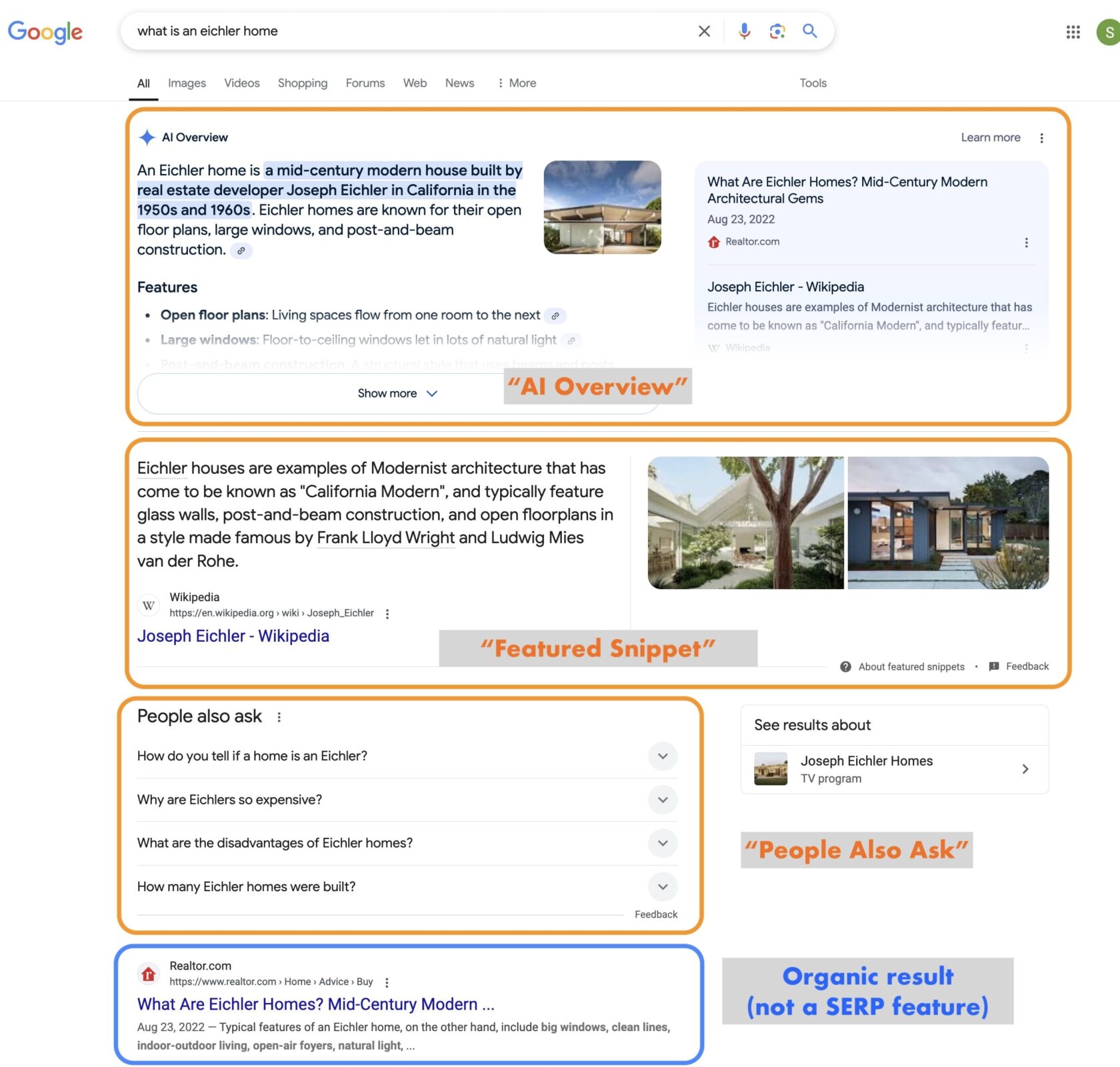
To increase your website’s chances of showing as a SERP feature, you should create dedicated sections on your property website that directly address frequently asked questions about the property and neighborhood. For example, include headings like “What amenities are nearby?” or “How far is this property from downtown?” Google often pulls featured snippet content from pages that clearly answer specific questions.
Your domain should be intuitive, simple to remember, and ideally give potential buyers a quick hint about the property’s location. The best domain names are short, descriptive, and roll off the tongue easily.
For most single-property websites, using the actual street address ( for example, 1234Central.com) works well because it’s specific, unique, and immediately informative.
The short answer:
While you technically can, you should generally not use multiple domains for your website.
The long answer:
Multiple domains might seem like a smart marketing strategy, but in the world of SEO, it’s more likely to confuse than clarify. This is why we typically advise against pointing or creating redirects – especially if SEO is a goal.
The big issue is that using multiple domains to point to new, duplicate, and short content (all of which apply to single page websites) makes it look like you are trying to swindle Search Engine Page Results (SERPs). In response to this, Google and Bing will rank the sites as very “toxic” and reduce their Domain Authority – thus diminishing their SEO and ability to appear in SERPs.
The best strategy for increasing Domain Authority is creating a lot of backlinks to a single domain.
It can be frustrating for agents to Google their property and not immediately see their site listed as a top result. When your website is published, we use all the proper SEO code and mechanics to make sure your property site is indexed by search engines like Google. We even submit the website to Google to begin the robot indexing process. That being said, brand-new sites do take a while to show up because they have not yet been ranked as an authority on the property content.
It’s also important to consider how people find properties and what the value of a custom property site actually is. Many potential buyers discover your custom property URL on your brochures, listing sites, MLS, “For Sale” signs, and other marketing channels. This means your Google rank may not be as valuable as other ways that people find and search for your site. These links through other channels are often the most effective at getting the word out, and the real value of having a custom property site is isolating your property listing to the viewer and tailoring it to your specific brand.
After learning about how search engines prioritize their results and the unique struggles that come with single property websites, you might think it’s impossible for your property website to satisfy Google’s demanding criteria.
The good news? There are some practical solutions you can implement today to help optimize your site’s SEO.
Pro-Tip: If you’re feeling unsure about where to start with social media, check out our Social Media 101 series here!
The short answer is yes, but luckily for you, we’re here to handle the technical side of SEO! We’ve developed optimization strategies that consistently place property websites on the first page of Google searches, with an average ranking around position 13.6.
So, what can you do to help? The most powerful SEO tool you bring to the table is your unique expertise as a real estate professional. While we manage the technical backend, your most important role is to breathe life into the listing. Share the home’s story, highlight the neighborhood’s charm, and describe those special details that transform a house into a potential home. When you share insights and details in your natural voice, you’re not just doing a great job at optimizing for search engines—you’re connecting with potential buyers in the most authentic way possible.